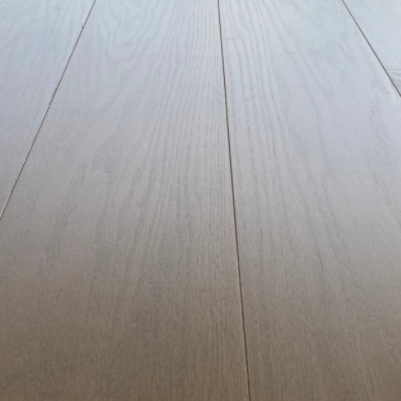
Engineered red oak flooring thickness should be written as two separate measurements: 20 mm total board thickness and a 6 mm red oak face. The 6 mm face is included within the 20 mm overall thickness. For VIF’s three-meter AB Grade product, the complete dimensional reference is 3000 × 190 × 20/6 mm. Record the dimensions, grade, construction, and approved appearance together, while leaving the specific plywood configuration subject to order confirmation. Thickness alone does not establish load capacity, a refinishing count, or service life.
1. Engineered Red Oak Flooring Thickness: Total vs Face
The notation “20/6 mm” is useful shorthand, but a project specification should explain both figures. Write “20 mm total thickness, including a 6 mm red oak face” so designers, buyers, and installers are working from the same description.The wood flooring wear layer in this product refers to the oak face. It should not be confused with the UV-lacquered coating listed separately in the specification.
Avoid recording only “20 mm engineered oak.” That description leaves out the face thickness, wood species, grade, and other identifying details. Equally, “6 mm oak” does not describe the complete engineered board.
For the reference product, show the dimensions in a consistent order: length × width × total thickness/face thickness. Keep that order across the product schedule, purchase documents, and any dimension illustrations.
2. Write a Complete Product Description
A thickness entry becomes useful when it identifies the product being purchased. VIF’s reference flooring is red oak, AB Grade, with a multilayer engineered construction. Its dimensions are 3000 mm long and 190 mm wide.
The substrate description is poplar/eucalyptus plywood, with the specific configuration confirmed for the order. This wording does not establish a mixed-species layer arrangement, a fixed layer count, or an all-poplar or all-eucalyptus construction.
Use the following checklist when preparing the specification.
Record engineered red oak flooring thickness as 20 mm overall, including a 6 mm red oak face.
| Specification Field | Wording for This Product | Confirmation Point |
|---|---|---|
| Wood species | Red Oak | Keep the species consistent across documents |
| Board dimensions | 3000 × 190 mm | State length × width |
| Total thickness | 20 mm | Identify it as overall board thickness |
| Oak face | 6 mm red oak face, included in total thickness | Keep separate from the coating description |
| Construction | Multilayer Engineered | Do not add an unconfirmed layer count |
| Substrate | Poplar/eucalyptus plywood; specific configuration subject to order confirmation | Obtain the final configuration |
| Grade | AB Grade | Agree on written appearance criteria and samples |
| Surface treatment | Brushed, Smoked | Match the approved product reference |
| Coating and edge | UV Lacquered; Micro-Beveled | Record separately from thickness |
| Installation | Glue-down | Review product guidance and project conditions |
Review the [AB Grade 3-Meter Red Oak Engineered Wood Flooring] when completing the product schedule. The product page and purchasing documents should describe the same selected flooring.

3. Confirm Grade and Appearance Independently
AB Grade and 20/6 mm describe different aspects of the product. Neither measurement defines the accepted appearance, and AB should not be translated into a completely knot-free promise.
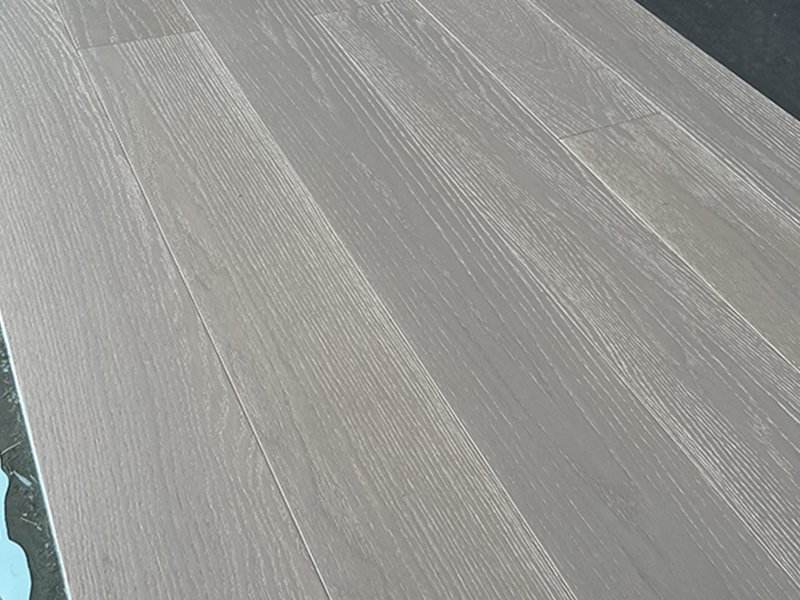
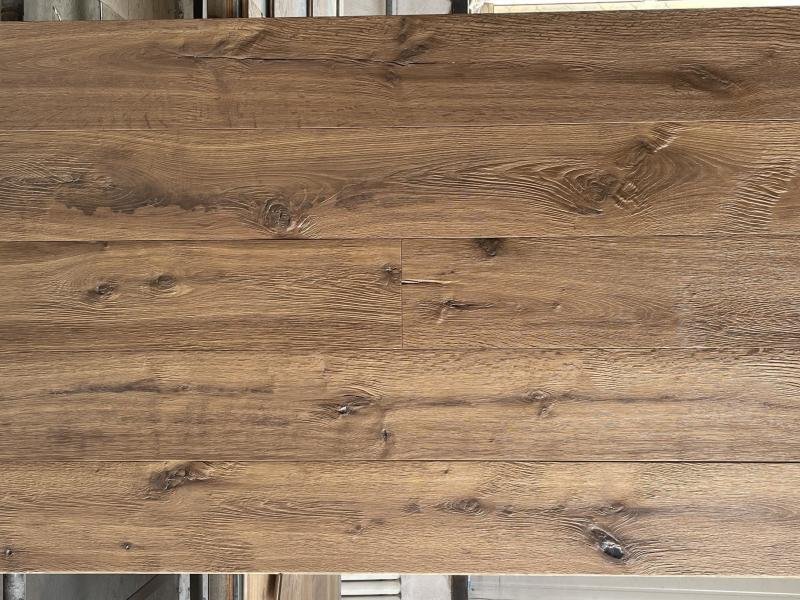
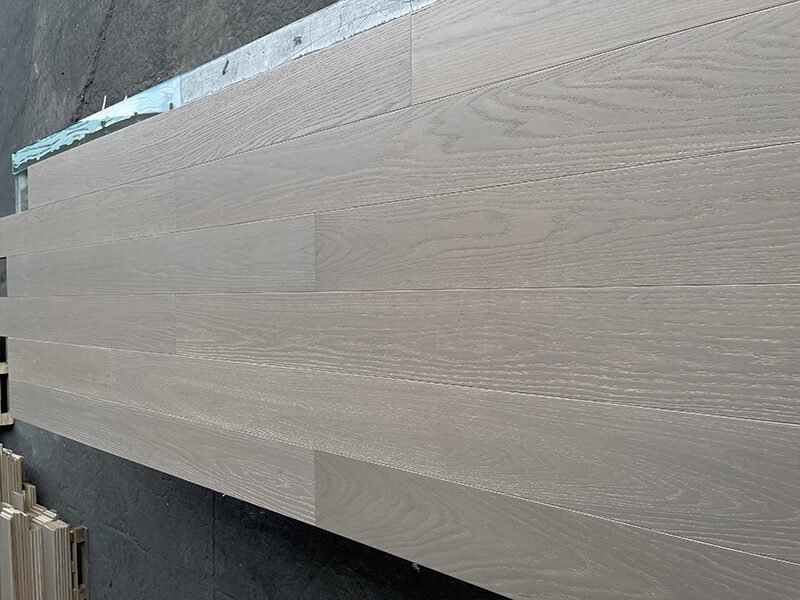
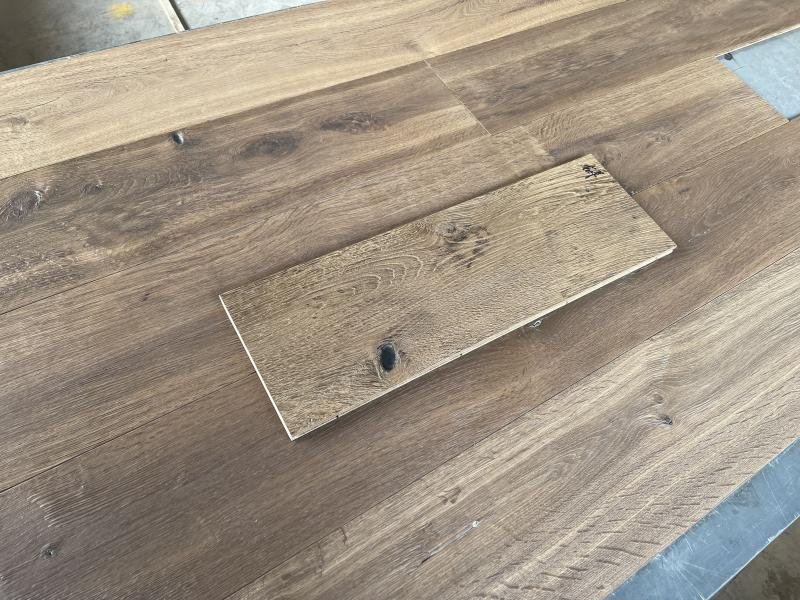
Agree on the written grade requirements and review the corresponding physical sample. Record the approved color, surface treatment, and coating alongside the grade. The listed color direction is Natural Oak/Stain, and color customization is supported.
A project team may approve the thickness while the color is still under review. Make that status clear rather than treating one approval as acceptance of the entire specification.
For a villa or hotel material review, compare the flooring sample with the intended cabinetry, stone, wall finishes, and textiles. Discuss the acceptable natural variation through the sample and written criteria. Do not expect every board to reproduce one small sample exactly.
4. Keep Installation Review Separate from Thickness Approval
The confirmed installation method is glue-down. A 20 mm thickness entry does not replace the product installation guidance or the installer’s review of the project.
Provide the relevant site information and drawings to the installation team. Ask them to confirm the installation details and any interfaces with adjacent materials. For the three-meter format, transportation, unloading, building access, and on-site handling also require project coordination.
Underfloor heating is listed as applicable, subject to the product installation guide and heating-system requirements. Do not derive temperature limits, humidity limits, or system settings from the thickness notation.
Similarly, the 6 mm oak face does not establish a guaranteed number of sanding or refinishing operations. Any future maintenance or refinishing proposal needs separate product-specific review. This article does not assign load-bearing performance or a commercial wear classification to the board.
5. Coordinate Stairs Without Copying the Floor Specification
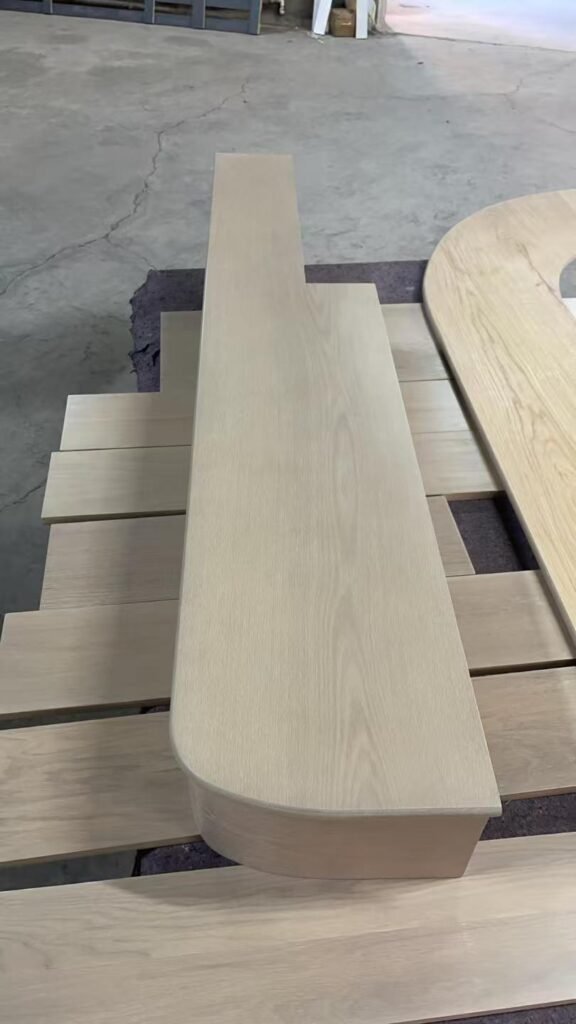
The matching AB Grade red oak stair treads and risers have 20 mm total thickness and a 2 mm oak face. Their 20/2 mm specification must remain separate from the floor’s 20/6 mm specification.
Matching refers to coordination of species, color, and overall appearance. It does not mean identical construction, face thickness, or an absence of natural color variation.
The stair reference dimensions are 1220 × 330 × 20/2 mm for treads and 1220 × 178 × 20/2 mm for risers. Confirm the dimension-to-use relationship in writing before finalizing drawings. Stair dimensions, shapes, and colors can be customized.
Review the [matching red oak stair treads and risers] as separate components. Confirm front edges, nosing, grooves, installation interfaces, and quantities through project drawings and approved samples. Do not transfer the flooring’s smoked treatment or 500-square-meter MOQ to the stairs.
6. Frequently Asked Questions
Does 20/6 mm mean 26 mm total thickness?
No. It means 20 mm overall thickness, including the 6 mm red oak face.
Does a 6 mm face guarantee a refinishing count?
No. Face thickness alone does not establish a guaranteed number of refinishing operations or a service-life promise.
Is the plywood configuration already fixed?
The confirmed description is poplar/eucalyptus plywood. The specific configuration needs order confirmation; do not infer a layer arrangement or layer count.
Can the floor and stair thickness entries be combined?
No. The floor is 20/6 mm, while the matching stair products are 20/2 mm. List them separately, even when their colors are coordinated.
Discuss Your Project Specification with VIF
Send your company name, project location, required flooring area, color reference, and purchasing schedule. Include the proposed 3000 × 190 × 20/6 mm specification and any stair requirements so VIF can coordinate product information, sample review, and order details.